BEGIN:VCALENDAR
VERSION:2.0
PRODID:-//Lassmann Education - ECPv5.3.1//NONSGML v1.0//EN
CALSCALE:GREGORIAN
METHOD:PUBLISH
X-WR-CALNAME:Lassmann Education
X-ORIGINAL-URL:https://lassmanneducation.eu
X-WR-CALDESC:Events for Lassmann Education
BEGIN:VTIMEZONE
TZID:Europe/Paris
BEGIN:DAYLIGHT
TZOFFSETFROM:+0100
TZOFFSETTO:+0200
TZNAME:CEST
DTSTART:20260329T010000
END:DAYLIGHT
BEGIN:STANDARD
TZOFFSETFROM:+0200
TZOFFSETTO:+0100
TZNAME:CET
DTSTART:20261025T010000
END:STANDARD
END:VTIMEZONE
BEGIN:VEVENT
DTSTART;TZID=Europe/Paris:20260605T080000
DTEND;TZID=Europe/Paris:20260607T170000
DTSTAMP:20260414T220806
CREATED:20201125T133955Z
LAST-MODIFIED:20260226T075350Z
UID:1136-1780646400-1780851600@lassmanneducation.eu
SUMMARY:UPDATE
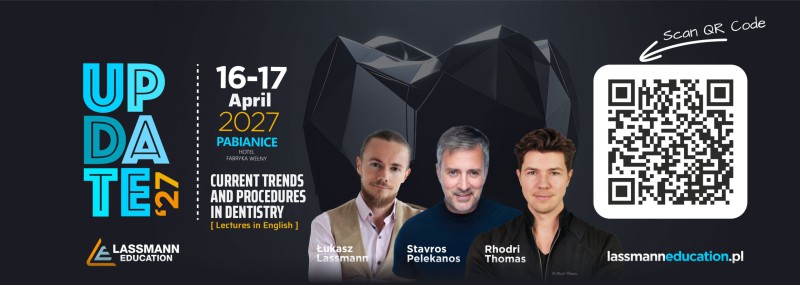
DESCRIPTION:[vc_row][vc_column]\n			 \n			\n				\n					\n						\n							\n79 \n								 \n								EURO \n								DAYS \n								 \n								 \n								POINTS \n								 \n								 \n								 \n													\n					\n				\n				\n			\n			\n[vc_column_text] \nLASSMANN EDUCATION – UPDATE Symposium\nLassmann Education (formerly Master Level) is proud to present the UPDATE SYMPOSIUM.Join us and experience unforgettable moments while gaining valuable knowledge from the best experts in the industry. This is an event that will transform your approach to dentistry and support your professional development at the highest level.[/vc_column_text][/vc_column][/vc_row][vc_row][vc_column][vc_column_text] \nLecturers \n[/vc_column_text][/vc_column][/vc_row][vc_row el_class=”lecturers-info”][vc_column width=”1/5″][vc_single_image image=”5804″ img_size=”medium” title=”Łukasz Lassmann”][/vc_column][vc_column width=”1/5″][vc_single_image image=”11718″ img_size=”medium” title=”Riaz Yar”][/vc_column][vc_column width=”1/5″][vc_single_image image=”11716″ img_size=”medium” title=”Jorge Andre Cardoso”][/vc_column][vc_column width=”1/5″][vc_single_image image=”11715″ img_size=”medium” title=”Davis Thomas”][/vc_column][/vc_row][vc_row el_class=”lecturers-info”][vc_column width=”1/5″][/vc_column][vc_column width=”1/5″][/vc_column][vc_column width=”1/5″][/vc_column][vc_column width=”1/5″][/vc_column][/vc_row][vc_row][vc_column width=”1/4″][vc_message style=”square” message_box_color=”white” el_class=”box-gora pomaranczowy”] \n5-7 June\, 2026\nMercure Hotel Old Town\, Gdansk\n[/vc_message][/vc_column][vc_column width=”1/4″][/vc_column][vc_column width=”2/4″][/vc_column][/vc_row][vc_row][vc_column][vc_tta_accordion shape=”square” active_section=”9999″ collapsible_all=”true” el_class=”pomaranczowy”][vc_tta_section title=”05.06.2026 Day I” tab_id=”1769435389062-b2f67046-6a2b”][vc_column_text] \nFRIDAY\nŁUKASZ LASSMANN\n9:00–10:00 \nWhat truly matters today in FMR and TMD?A lecture on which protocols are worth simplifying\, which should be abandoned\, and which genuinely enhance treatment safety. No dogmas\, no rigid schemes – just the intersection of function\, aesthetics\, and pain. \n________________________________________________________________________________________________________________________________________________________________________________________________________________ \n10:00-10:30 break \n________________________________________________________________________________________________________________________________________________________________________________________________________________ \nDAVIS THOMAS \n10:30–12:00 \nSystemic factors affecting FMR \n\nWhat systemic factors in a patient can affect the success of your grafts and implants ? How can you prevent related failures?\nWhat diseases and disorders lead to failure of your restorations ( preventing loss of your FMR cases)?\nHow does factors such as diabetes\, endocrine disorders\, gastric reflux\, secondary bruxism\, and many more predispose to FMR failures: how can we prevent and mitigate ?\n\nSystemic factors affecting TMD \n\nWhat systemic diseases can cause\, aggravate and perpetuate jaw pain\, TMDs and TMJ pain: how to recognize these factors? How to avoid frustration of inability to control TMD pain ?\nWhat makes Postoperative pain prolonged? How can we manage ?\nHow can you manage a nerve damage case ? What are the systemic factors affecting chronic post op pain ?  Management ?\n\n________________________________________________________________________________________________________________________________________________________________________________________________________________ \n12:00-12:30 break \n________________________________________________________________________________________________________________________________________________________________________________________________________________ \n12:30–14:00Pharmacotherapy for TMDs \n\nWhat are the principles of sound and successful management of Pain ( Post operative; TMJ\, TMD) ? Correct methods of pharmacotherapy\nHow do you manage TMD/TMJ pain in the context of FMR?\nWhat are the analgesics ( conventional and new) that can be utilized for successful management in Dentistry ?\n\n________________________________________________________________________________________________________________________________________________________________________________________________________________ \n14:00- 15:00 lunch \n________________________________________________________________________________________________________________________________________________________________________________________________________________ \n15:00–16:30 \nSystemic factors affecting Dental treatment prognosis \n\nWhat are the systemic factors that affect success of Endodontic treatments?\nWhat medications cause failure of restorations\, grafts\, implants and tooth structure ?\n\n________________________________________________________________________________________________________________________________________________________________________________________________________________ \n16:30–17:00 \nPanel discussion \n[/vc_column_text][/vc_tta_section][vc_tta_section title=”06.06.2026 Day II” tab_id=”1769435388530-4681adce-987b”][vc_column_text] \nSATURDAY\nJORGE CARDOSO\n11:00–12:15A simplified framework for interdisciplinary complex cases \nInterdisciplinary dentistry is nowadays an absolute need in any small or large dental office. Patients\, needs\, scientifics advances and digital dentistry allowed and demanded that a coordinated team perform treatments that include periodontology\, orthodontics\, implant dentistry\, restorative dentistry and prosthodontics. In this lecture\, the author\, as a prosthodontist will present a simplified thought process and cover important aspects to facilitate successful workflow\, patient management and team communication throughout diagnosis\, treatment planning and execution of simple and complex cases. \n________________________________________________________________________________________________________________________________________________________________________________________________________________ \n12:12-12:45 break \n________________________________________________________________________________________________________________________________________________________________________________________________________________ \n12:45–14:00Choosing anterior ceramics – structure\, color and biotype \nThe choice of the most adequate dental preparation and ceramic type in the anterior esthetic region is still a challenge even for more experienced clinicians. Typical restoration failures include: darkish/greyish optical effects\, lack of value\, dark margins\, gingival recession and of course abutment and/or ceramic structural failures. Instead of following commercial advice or trends that lack evidence\, a decision process will be presented to minimize these failures.\nUsing the Concept of Restorative Volume the author will present recommendations based on: \n\nStructure – “ferrule” design\, palatal ridges and remaining enamel\nColor – preparation depth for color change\, “umbrella” effect and how to deal with minimal layering trends\nGingival Phenotype – minimizing recession\n\n________________________________________________________________________________________________________________________________________________________________________________________________________________ \n14:00–15:15 lunch \n________________________________________________________________________________________________________________________________________________________________________________________________________________ \n15:45–17:00Implant prosthodontics critical aspects – single to full mouth \nThe rapid knowledge advances of the perio-restorative interface\, transmucosal design and digital workflows have made implant prosthodontics an ever changing field.\nIn this author the author will cover: \n\n ideal implant position\nabutment design and choice\nimportance of soft tissue\nprosthodontic workflow\nimpression and try-ins\nprosthetic design and biomechanical aspects\nFp1 and Fp3 decision making and clinical aspects\n\n________________________________________________________________________________________________________________________________________________________________________________________________________________ \n17:00-17:30 break \n________________________________________________________________________________________________________________________________________________________________________________________________________________ \nARTUR MAKIEŁA\, TOMASZ FALKOWSKI\n17:30 -21:30Lecture and practical session on hypnosis in dentistry \n[/vc_column_text][/vc_tta_section][vc_tta_section title=”07.06.2026 Day III” tab_id=”1769435386495-eeb722ac-f29b”][vc_column_text]SUNDAY \nRIAZ YAR \n9:00- 10:30 \nDigital Occlusion: How Accurate Are We? \nDigital occlusion is now embedded in restorative and multidisciplinary workflows\, yet “accuracy” is often assumed rather than critically verified. This lecture explores where occlusal accuracy is gained or lost along the digital chain: data acquisition\, alignment and registration\, virtual articulation\, dynamic simulation\, manufacturing tolerances\, and clinical verification.Delegates will learn how to define accuracy in clinically relevant terms (not only technical ones)\, identify common sources of error\, and apply pragmatic validation steps to improve predictability from scan to design to delivery. \nAim: To provide a structured\, clinically relevant framework for evaluating and improving the accuracy of digital occlusal workflows from data acquisition to chairside verification. \nLearning outcomes: \n\n\nDefine “accuracy” in digital occlusion in clinically meaningful terms (static contacts\, functional movements\, patient adaptation). \n\n\nIdentify key sources of error within the digital workflow (scan strategy\, registration\, alignment\, articulation\, and manufacturing tolerances). \n\n\nApply a simple validation pathway to confirm occlusal reliability before irreversible steps (prep refinement\, milling/printing\, cementation). \n\n\nRecognise red flags indicating when a digital workflow should be supplemented with analogue cross-checks. \n\n\n_______________________________________________________________________________________________________________________________________________________________________________________________________________ \n  \n10:30- 11:00 break \n______________________________________________________________________________________________________________________________________________________________________________________________________________ \n11:00- 12:30 \nDigital Occlusion in Practice: Turning Data Into Predictable Function \nThis lecture translates accuracy principles into everyday clinical decision-making for restorations and occlusal adjustments. It focuses on practical strategies to reduce remakes and chairside adjustment time\, including optimised scanning and bite capture\, reproducible reference positions\, management of patient-related variables\, control of software defaults\, and the use of digital metrics to guide refinement.Real-world clinical cases demonstrate how digital occlusal data can be integrated with functional examination to avoid over-adjustment\, iatrogenic interferences\, and postoperative discomfort. \nAim: To equip clinicians with a repeatable and efficient method for converting digital occlusal data into predictable functional outcomes in both routine and advanced cases. \nLearning outcomes: \n\n\nImplement a step-by-step “digital occlusal journey” that minimises variability from scan to delivery. \n\n\nSelect scanning and registration strategies that improve repeatability\, including when to rescan and when not to. \n\n\nInterpret digital occlusal outputs in relation to functional findings (guidance\, interferences\, muscular response\, envelope of function). \n\n\nCommunicate occlusal objectives more effectively with the laboratory using digital records and shared reference points. \n\n\n______________________________________________________________________________________________________________________________________________________________________________________________________________ \n12:30-13:00 break \n______________________________________________________________________________________________________________________________________________________________________________________________________________ \n13:00-14:30 \nDemonstrating Functional Occlusion With 4D Technology: From Static Contacts to Dynamic Function \nThis live demonstration presents a complete functional occlusal workflow using 4D technology to visualise and assess occlusion over time and during mandibular movement. Participants will observe how dynamic occlusal data are captured\, processed\, and interpreted\, how they are integrated into digital articulation and restorative design\, and how the results inform safe and efficient clinical adjustment strategies.The session is highly practical and “tips and tricks” oriented\, focusing on small but impactful refinements that significantly improve clinical outcomes. \nAim: To demonstrate the clinical application of 4D functional occlusal data for diagnosis\, restorative planning\, and chairside occlusal refinement. \nLearning outcomes: \n\n\nUnderstand the setup and execution of a reproducible 4D functional occlusion recording protocol. \n\n\nObserve how 4D findings are integrated with digital articulation and design to reduce post-insertion adjustments. \n\n\nLearn how to generate a concise digital occlusion report to support laboratory communication\, documentation\, and informed consent using Sphere. \n\n\nEmbedded “tips and tricks” themes (lecture + demo) \n\n\nStandardising bite capture to reduce variability (repeatability checks and re-capture triggers) \n\n\nManaging scan artefacts that mimic occlusal discrepancies \n\n\nKnowing when to trust digital contacts\, when to cross-check\, and how to do so efficiently \n\n\nA simple pre-cementation verification checklist to prevent clinical surprises \n\n\nDocumentation pearls: recording digital occlusal findings in a defensible and clinically meaningful manner \n\n\n______________________________________________________________________________________________________________________________________________________________________________________________________________ \n14:30-15:00 Conclusion[/vc_column_text][/vc_tta_section][/vc_tta_accordion][/vc_column][/vc_row][vc_row][vc_column][vc_separator border_width=”3″][vc_column_text] \nPrinted Guidebook\n[/vc_column_text][/vc_column][/vc_row][vc_row el_class=”waski-grid”][vc_column width=”1/5″][vc_single_image image=”3784″ img_size=”medium”][/vc_column][/vc_row] \n\n        \n                \n                    Facebook\n                \n            \n                \n                    LinkedIn\n                \n            \n                \n                    Instagram\n                \n            \n                \n                    You Tube
URL:https://lassmanneducation.eu/event/update/
ATTACH;FMTTYPE=image/jpeg:https://lassmanneducation.eu/wp-content/uploads/2020/11/kaf-UPDATE-2026.jpg
END:VEVENT
END:VCALENDAR